
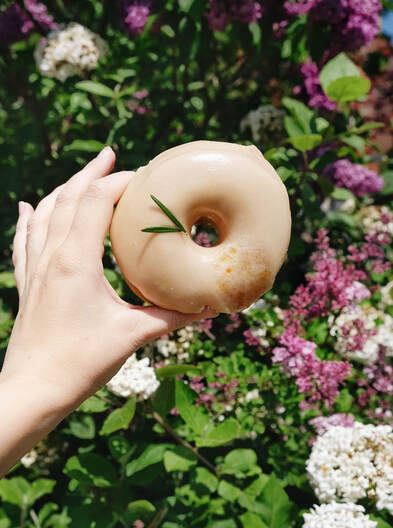
 Rosemary Maple Brûlé Rosemary Maple Brûlé For Immediate Release
June 4, 2019 Hamilton Pollinator Paradise Project & Donut Monster: Pollinator Awareness Campaign Celebrating & Raising Awareness About Pollinators Throughout June Pollinators are a sweet deal! That's why the Pollinator Paradise Project is partnering with Donut Monster throughout June to raise awareness about the vital work these little critters do. By pollinating wild plants and food crops, they help provide one out of every three bites of the food we eat. To this end, Donut Monster’s “Pollinator Donut”--a Rosemary Maple Brûlé--delivers a tasty bite with a very serious message. “Pollinator populations are rapidly declining due to factors such as habitat loss, pesticide use, and climate change,” says Project Manager, Jen Baker. “In fact, the recent UN global biodiversity assessment estimated that about 1 in 10 insect species are threatened with extinction.” The loss of pollinators (and biodiversity in general) means serious negative impacts on the health of our ecosystems. “We’re excited about creating the Maple Rosemary Brûlée donut to bring awareness to the Hamilton Pollinator Paradise Project,” say owners Heidi and Reuben Vanderkwaak. “It is a very tangible way for the community to get involved. The donut has an amazing flavour and we really hope that highlighting this project will cause our customers to stop and consider how they can find simple ways to improve biodiversity in Hamilton.” Many ways to Help. Many ways to Celebrate. The Hamilton Pollinator Paradise Project is planting a paradise for pollinators across Hamilton by creating habitat with native trees, shrubs, and wildflowers. Because the need to raise awareness about the plight of pollinators is so urgent, the project is taking National Pollinator Week (June 17-June 23) and making a Pollinator Month of it! HERE'S WHAT YOU CAN DO:
Supporting pollinators is a win-win-win for everyone--pollinators, plants, and people! Learn more about the project: https://www.hamiltonpollinatorparadise.org/ For more information or to arrange an interview, contact: Beatrice Ekoko, Communications Manager at bekoko@environmenthamilton.org or call 905 549 0900.
0 Comments
 The Ford Government has announced changes to Ontario's Endangered Species Act & these changes will only put endangered species at greater risk! Visit Environment Hamilton to get details and help in preparing written comments to submit to the province through the Environmental Registry of Ontario.
Environment Hamilton held workshops earlier this month, and has made the slides from the workshop available on the website. A FACTS & ACTION SHEET is also provided on the website. It covers everything you need to know about the proposed changes to Ontario's Endangered Species Act and how you can submit your comments to the province. CLICK HERE to the Environmental Registry Posting. Deadline to submit comments is Saturday May 18th, 2019. If you have any questions we are here to help! Email Juby at jlee@environmenthamilton.org or call the office 905-549-0900  Hamilton Monarch Awards 2019: For gardens that nature loves, by gardeners who love nature!
Hamilton has a unique garden award program that recognizes function as well as good looks. The Monarch Awards (since 2016) showcase and champion gardeners who create nature-friendly spaces full of native plant diversity, pollinator habitat, healthy soil, and sustainable, ecologically sound approaches to garden care. In 2018, the Monarch Awards added a new category for beginners who have just begun their “gardening for nature” journey. The Caterpillar Award recognizes those gardeners who are on their way to becoming mature Monarchs. ***NEW in 2019*** Changes to the 2019 Monarch Awards include the following: *A move away from the competition aspect of the awards in favour of offering an inclusive opportunity to celebrate more of the work being done by nature gardeners across Hamilton. *No longer a contest, the Monarch Awards will become a standard of excellence. Instead of looking for “the best” gardens we’ll be looking for all the really good ones, made by gardeners who are consciously and knowledgeably creating places where nature can thrive. *Entrants can look forward to more garden visits next year. Visits include feedback, encouragement, and suggestions from the judges. The six categories (soil, water, plants, materials/hardscaping, cultural practices, and aesthetics) remain the same and judges will be looking for achievements in each of these areas. Apply today to one of these programs. It’s free! Entry deadline is midnight Sunday on June 30, 2019. Judges’ site visits are scheduled for mid-July. Questions? Send us an email admin@monarchawardshamilton.org For more information visit http://monarchawardshamilton.org/ The Monarch Awards is a collaborative program of the Hamilton Pollinator Paradise Project (Environment Hamilton and the Hamilton Naturalists’ Club), the Crown Point Garden Club and the Royal Botanical Gardens. The City of Hamilton takes a great interest in this program and supports our efforts yearly by hosting the Awards celebration at City Council Chambers.  Pollinator Garden Construction: Carmeuse, Dundas. Pollinator Garden Construction: Carmeuse, Dundas. Lime and Limestone company, Carmeuse has planted pollinator gardens at their Dundas and Beachville sites. Carmeuse’s management team looked to Ingrid Hengemuhle, Area Quality Control Manager for Canada, to develop the pollinator gardens. According to Hengemuhle, “With the support and encouragement of Carmeuse management, our employees and members of the community worked hard to create the pollinator garden that has become a functional beautification at our plant.” The 600 square foot, two-tiered Dundas garden was created in the fall of 2018. The design was in-house: “We have the heavy equipment, the armor stone and the staff. Staff volunteers will maintain the garden,” John Tennant, Carmeuse Site Operations Manager at Dundas, said. “This is a beautiful result of combined efforts to work together on something that has a sustainable impact.” 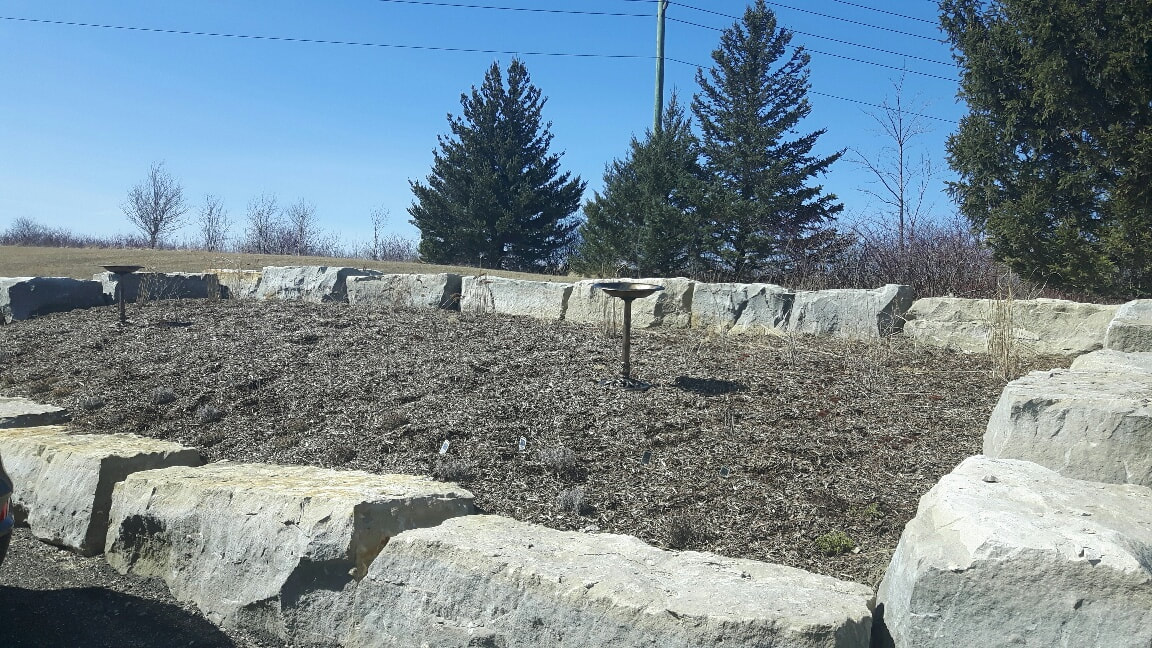 Pollinator Garden construction: Carmeuse, Beachville Pollinator Garden construction: Carmeuse, Beachville A second 500 square foot garden was also created at Beachville.
Local nurseries worked with the teams in selecting a variety of native plant species that would be in bloom in the garden from early spring to late summer. This is necessary for hungry pollinators seeking food and shelter in addition to a place to reproduce across these seasons. “It’s incredible. I didn’t realize there were so many different native plants that were attractive to pollinators,” Hengemuhle remarks. The entire process to assemble the gardens took a month. The Carmeuse Dundas garden is now included on the Hamilton Pollinator Paradise Project map to help build a Pollinator Corridor across the city, and with this program’s “We are Feeding Pollinators” sign staked firmly in the ground at the site, Carmeuse employees are eagerly waiting for the warmth to bring out the flowers and attract wild bees, butterflies, small birds, and other little beneficial critters. 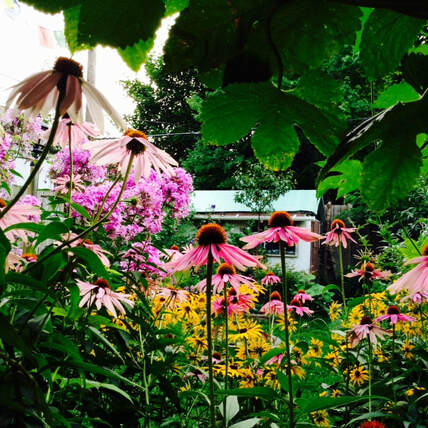 Planting native species to support nature and biodiversity is becoming more popular. This is great news for declining pollinator populations. At the same time, there are a number of myths and misconceptions around native plant gardening and pollinators that we are going to dispel in this blog post. Happy gardening for nature!
Native plant gardens are weedy and unruly Truth: With thoughtful plant selection and design, and proper maintenance, native species gardens are gorgeous. As we do with all ornamental plants, gardeners select natives to serve particular design functions. Is it tall enough to go at the back of the border? Does it bloom when we want it to--either when nothing else is blooming, or when the bloom colour will coordinate with other plants blooming at the same time? Does it have a form or habit (upright, sprawling, arching) that works with the plants around it? It’s simply a matter of researching the plant habit, and understanding that, when placed in rich garden loam with lots of elbow room, many native plants will get bigger, and spread faster, than they would in a natural setting. Native plants can be enthusiastic re-seeders in a garden. You can minimize the deluge of seedlings every spring by deadheading (cutting off the spent flowers) during the growing season or, if the seed heads are eaten by birds, just leave them. Roguing out seedlings in the spring is a learning opportunity, an excellent way to get up close and personal with your garden while providing plenty of seedlings to give away. Many gardeners are also concerned with aggressive spreading through runners. It is true that SOME native species are aggressive spreaders but not all are! Canada Goldenrod is one aggressive species but do not judge all goldenrods by this one species behaviour! We have many species of goldenrods that are very mild mannered and will not spread by runners at all. Some well-behaved goldenrods include Stiff Goldenrod (Solidago rigida) for dry sun and Blue-stem (Solidago caesia) or Zig-zag Goldenrods (Solidago flexicaulis), for part shade). Goldenrods are bountiful contributors to biodiversity and are great pollinator plants. Although common milkweed (Asclepias syriaca) has a far-wandering root system, there are several species that work well in gardens. These “clumpers” include: Swamp Milkweed (Asclepias incarnata, good for loamy garden soil); Butterfly Milkweed (Asclepias tuberosa, good for drier spots); and Poke Milkweed (Asclepias exaltata, good for part shade.) There’s no harm in staking or supporting native plants if they get floppy or too tall. You can also cut them back to keep them shorter, although this may delay the bloom time by a week or so. And there’s no rule against mixing native and non-native in your garden--it’s not all or nothing! For choosing suitable native plants, visit the Ontario Native Plants website. Check out our Resources and Guides page. Preserving and Enhancing the Genetic Diversity of Southern Ontario Plants with Puslinch Naturally Native Trees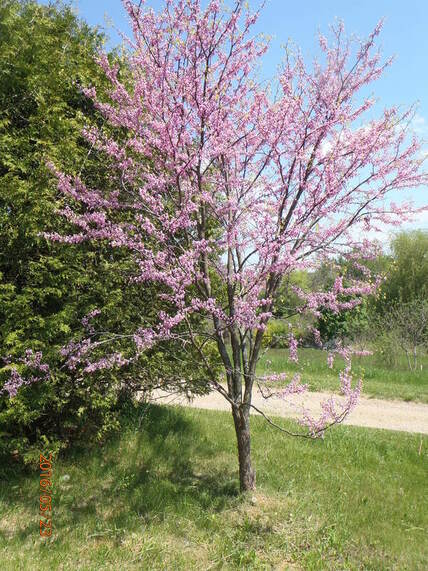 The Redbud tree is very beneficial to a wide range of pollinators. The Redbud tree is very beneficial to a wide range of pollinators. “I love the winter time,” Marion Robertson says to me, over the speakerphone. She’s got the kettle on and lets me know that her husband and business partner Richard, may be popping in and out of the conversation. They are owners of Puslinch Naturally Native Trees, a nursery plant stock supplier. Now that the snow is thick on the ground, it’s the ideal time to do inventory and plan for the spring.
“I can research other classes of plants and trees and spend the next year sourcing them,” she says. Marion shares a little about the origins of the business. They began as beekeepers (and still are). Richard chimes in, “We started growing trees, shrubs and wildflowers because of the honeybees and also endangered pollinators. You start out looking at one aspect; originally it was asking ourselves how we could help.” With the best of intentions in mind, the couple purchased trees and shrub stock from local area nurseries. But what they discovered was that within a year, a good portion of these trees and shrubs had died. The lesson learned? “A Latin, botanical name only ensures you are getting that specific plant. It does not indicate the origin of the seed,” Marion says. Plants from locally collected seeds have a much higher survival rate than those plants imported from outside an area’s growth zone. “It was next to impossible to find Carolinian or native stock from seed collected in our area at our local nurseries. That’s why we started our nursery business.” 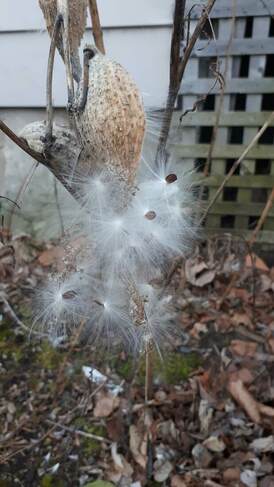 "To appreciate the beauty of a snowflake, it is necessary to stand out in the cold," Aristotle.
Winter is here! Underfoot, the snow crunches, the ice is slippery and we dream of the return of spring. But the world is beautiful for those who have eyes to see. Even in these cold months, there's a lot to see of nature. It's a hardier nature, a sleepy-headed, resting nature, a more subdued nature to see, the colours are subtle in the low light of the sun. Wind blows the dry milkweeds seeds off their pods, leaves crumble hiding hibernating critters, and we need to be careful not to disturb their slumber. I for one, admire the tenacity of the little plants and creatures, their patience, their pace, and I think it is a pace I wish I could adopt, but life hurries us on. Still, I make the time to stop, and watch and take a picture or two, because our campaign, My Hamilton Includes Nature, is year round. There is so much to see: from red fox, birds of all kinds (still hoping to see snowy owls), plants, insects, spiders, to fungi including lichen on trees. We invite you to join us in sharing with us the nature that is all around. Please use the hashtag #HamOntBiodiversity and tag us on instagram @hamiltonpollinatorsproject 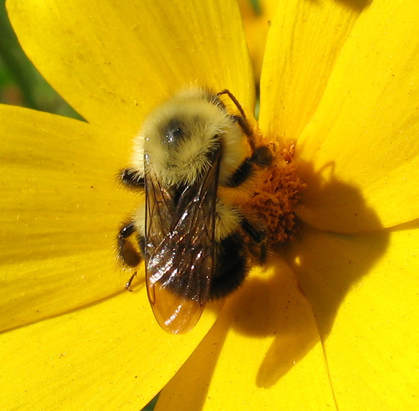 Eastern Bumblebe – Bombus impatiens, on Lance-leaf Coreopsis. Eastern Bumblebe – Bombus impatiens, on Lance-leaf Coreopsis. We connected with ecologist Brenda Van Ryswyk of Conservation Halton to get her thoughts on what we need to do to bring more nature to the city, and encourage more people to help build the Polliantor Corridor. Check it out:
Q: We have heard of the concept "Half for Nature." Is this realistic in a city? In Hamilton? If so, how can this be achieved? A: I think it is realistic when looking at available/plantable space and innovative planting techniques. I think we need to aim for it. We can utilize different ways to achieve this. Removing areas that do not need to be paved and converting them back to greenspace is one way. Innovative ways also should be looked at: vertical gardens (pockets of plants going up walls of buildings/high rises), patio gardening, rooftop gardens etc (I bought some durable fabric ‘pockets’ to fill with soil and hang on my fence). These are some creative ways we can incorporate more plants into our surroundings even if we do not have the bare earth on the ground. Q: What can be done at the municipal level? A: We need to look at using native species on public lands and city gardens. The city can have policies that they themselves will plant natives whenever possible. Park planning should plan to have natives in the landscape and design gardens to incorporate natives into the foundation plantings. I feel cities should be planting native woodies almost exclusively. There is no need to be planting non-native Norway Maple as a street tree/ornamental when a native tree can/should be used (in some situations a non-native may be needed but in my mind that is rare….most non-native woodies currently used in city plantings will have a native species that will do the same job!). The city (or region even) could have policies in place that encourage corporate or private landowners to plant natives as well. Any time a planting is done, the request can be made that it be native, especially for woody plants-- or have at least 50% natives for herbaceous plantings. It may not be enforceable but just having a "request" can sometimes trigger using more natives. Once it is out there it will likely be acted on. Once people (or corporations) understand the WHY they may go beyond the minimum recommendation. Having a voluntary ‘certification’ or something can also encourage participation, for example, if corporations use 50% or more native plants they get a “helping wildlife/pollinators” title they can then brag about, put on their signs, put on their website/social media etc. 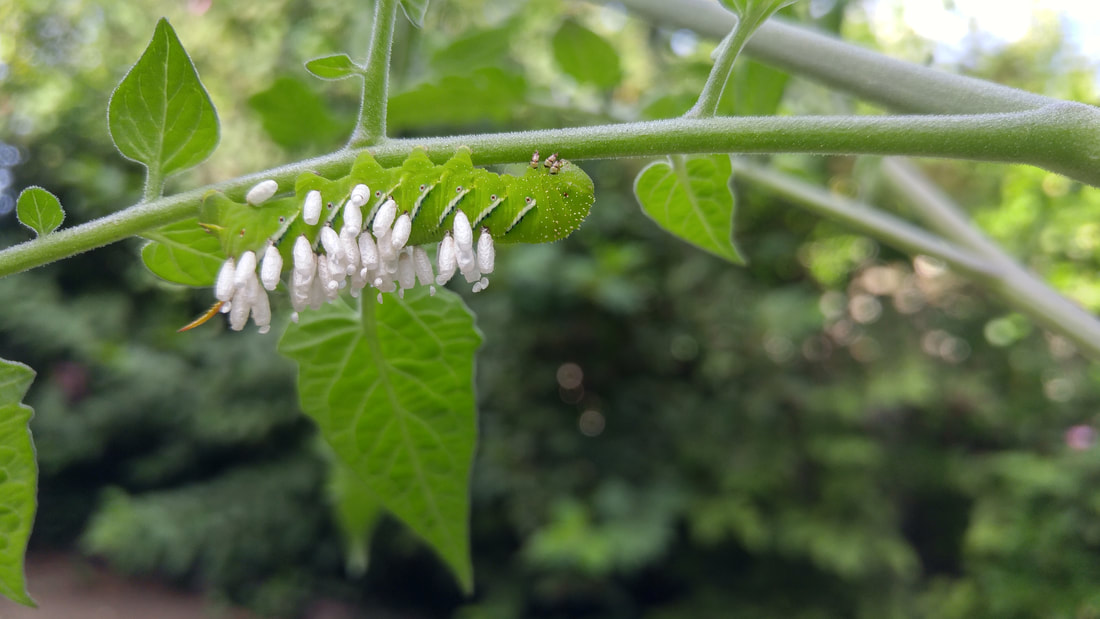 Intriguing! Terri shares a photo of a tomato hornworm she found in September on her heritage tomato plant. It had been parasitized by a parasitic wasp and the cocoons from its young remained on the hornworm's back after the young adults emerged. Intriguing! Terri shares a photo of a tomato hornworm she found in September on her heritage tomato plant. It had been parasitized by a parasitic wasp and the cocoons from its young remained on the hornworm's back after the young adults emerged. Terri Bocz, winner of the Caterpillar Awards of the Monarch Awards, 2018. Terri Bocz has always been a gardener. As a parent, when her children were young, she encouraged them to appreciate the natural world, nurturing their interest in little critters such as worms and ladybug larvae. She recalls that when she and her family lived in Mississauga, they had fennel which attracted the black swallowtail year after year: “that was my introduction. That caught me!” But it has been mostly in the last few years that Terri has intentionally been gardening for nature. Even then, “I was not a purist, most people don’t want to be purists. I used hybrids but we were advised to use natives.” Gardening for nature took a definitive direction after she heard native species gardener guru, Doug Tallamy speak about how critical caterpillars are for the development of baby birds. “It was a big factor to my awareness, learning that young birds need to be fed caterpillars so as to make bird feathers,” Terri says. She learned that in turn, most non-native plants are not digestible to caterpillars, so if an area is all non-native plants it is just like a desert with no food for the birds. Even more reason to plant native species! “Now I think about what will support the larvae. Why don’t we tell people that native plants are to support the caterpillars that birds can eat? Especially to get kids on board, since everyone wants to involve kids in gardening these days. They’ll get to their parents too. ”  Terri gets her plants from Ontario Native Plants, an online plant retailer, dedicated to supplying top quality native trees, shrub, grasses and perennials to customers all across Ontario.
"I want my garden to be attractive too. I saw a black swallowtail on my parsley. I don’t cut anything back in the fall, but i do in the spring. But I want to get the timing right." Checking in with Brenda Van Ryswyk, Natural Heritage Ecologist at Conservation Halton, spring is better than fall for cutting back. "Wait until there has been a week or two of above 10 degrees Celsius weather before cutting back and that should allow the overwintering critters to emerge," Brenda suggests. "Ideally don’t cut all the way to the ground at all, as last years plant stems will be this years nesting material, then they will overwinter in the stems and emerge the following year." Brenda advices that gardeners leave 8 to 10 inches of “stubble” all the time, which is "ideal." She explains that butterflies will often pupate in the leaves at the base of plants, "so just raking them to one side and leaving them there is fine, or leave in place," (don’t toss out or mulch if you know you had caterpillars nearby). What Terri loves about her garden Terri says that things grow so well in her garden, she loves to work on/in it: "I have lovely sandy soil. It’s rewarding, planting, transplanting, finding the right site for something where it thrives, that’s the thrill. I love the colours. Pollinators are thriving here. I will get even more excited when we get the beautiful caterpillars. We will bring them in and develop them inside. That’s going to be a big thrill.” About the Caterpillar Awards and the Monarch Awards To Terri, the Trillium Awards are “a competition about neatness. There was one here, from the person we got the house. I never was able to maintain that pristine standard.” Terri says she thinks that it is a good thing that the Caterpillar and Monarch Awards have strong criteria. “I like the Awards to encourage people. The inspection of the gardens was really helpful too.”  Fran Frazier with Mayor Fred. Fran Frazier with Mayor Fred. The weather is turning, fall is definitely here, but we are still basking in the afterglow of the Monarch Awards excitment. The Monarch Awards since 2016 is a way to celebrate gardeners who garden for nature. This year, the Monarch Awards extended a new category to include an award for small gardens and new gardeners: The Caterpillar Award.
I chatted with winner of the Caterpillar Award, Fran Frazier. Fran has always been a gardener, but it is only in the last four years, that she has been gardening for nature. It was through joining the Crown Point Garden Club and helping to plant pollinator gardens on the Pipeline Trail that Fran began to appreciate native plant gardens and what they do to support local biodiversity. Fran admits she was skeptical at first about such gardens, thinking that "weeds were for ditches." "I thought, milkweed in a garden? Are you crazy? Why do a garden full of weeds? I had no idea that a pollinator garden could be beautiful." But she knew that the monarchs needed milkweed and she went with it."And then I saw how gorgeous everything looked!. There was a huge difference in the number of bees and butterflies in the pipeline gardens, then ordinary gardens. It was absolutely teaming." Fran started learning more about the plight of pollinators. With her sister, who started the pollinator journey with her, supporting each other, Fran began attending tree walks, pollinator gardening workshops and forums. Now her sister, also a convert, is actually working on a complete butterfly garden. "My sister's neighbour came up to let her know he sees Monarchs all the time, and what's the big deal about declining numbers?" Fran laughs. "It's because of her garden attracting them!" Fran displays the "We are feeding Pollinators" sign Monarch Awards entrants receive in the window. Neighbours have, observed that she has more bees in her yard. What Fran loves about her garden "From everywhere you sit you can see bees and butterflies and birds," Fran says. She has yellow finches hopping about on the coneflowers, water features such as a water fountain and bird baths. Now all she needs is a toad: "I would like to have a toad. Maybe if enough people plant they will come closer to the escarpment," she says hopefully. Plans for her fall/winter garden? "I'm planting a few more native plants such as zigzag goldenrod because I didn’t have enough native plants. This fall, she plans to leave her garden "mostly alone." |
Archives
December 2023
Categories |
 RSS Feed
|
|
Butterflyway Hamilton: www.facebook.com/butterflywayhamilton/
Environment Hamilton: https://www.environmenthamilton.org/ Hamilton Naturalists' Club: https://hamiltonnature.org/ |